
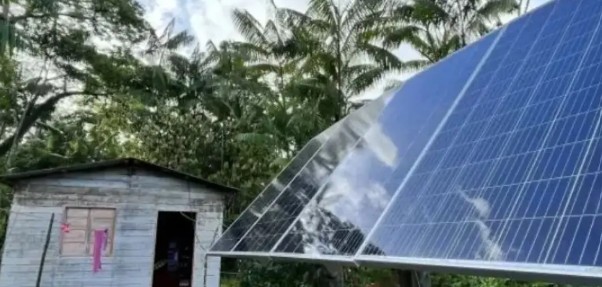
Scientists in Japan have unveiled a new material that could dramatically enhance the efficiency of solar panels, potentially allowing them to generate more energy from sunlight than previously thought possible.
++ Cornwall station to support NASA’s Artemis II moon mission
The research, led by a team at Kyushu University, centres on a novel “spin-flip” emitter capable of capturing energy that is ordinarily lost as heat. The development challenges the long-established constraints of conventional solar technology, with researchers suggesting it could enable energy conversion efficiencies of up to 130 per cent.
In standard solar cells, each particle of light—known as a photon—produces a single energy carrier, or exciton. However, a significant portion of solar energy, particularly from higher-energy light such as blue wavelengths, is typically wasted as heat, limiting overall efficiency.
The Japanese team has addressed this issue using a process called singlet fission. This technique splits the energy from a single high-energy photon into two lower-energy excitons, effectively increasing the amount of usable energy generated.
++ Women head to Turkey for drastic leg-shortening surgery
Associate Professor Yoichi Sasaki explained that there are two principal approaches to overcoming current efficiency limits: converting lower-energy infrared light into higher-energy visible light, or employing singlet fission to multiply excitons from a single photon. The findings were published in the Journal of the American Chemical Society, highlighting what researchers describe as a promising pathway towards significantly more efficient solar technologies.
The discovery comes amid a wave of innovation in the renewable energy sector. Earlier this month, scientists in Switzerland reported record-breaking efficiency levels using perovskite-based solar cells—often referred to as a “miracle material”. By combining perovskite with silicon, researchers were able to produce solar cells with performance approaching that of satellite-grade systems, but at considerably lower cost. Together, these advances point towards a future in which solar power becomes both more efficient and increasingly accessible.


